
Episode 1: David Morgan, General Counsel & Company Secretary at Warburtons
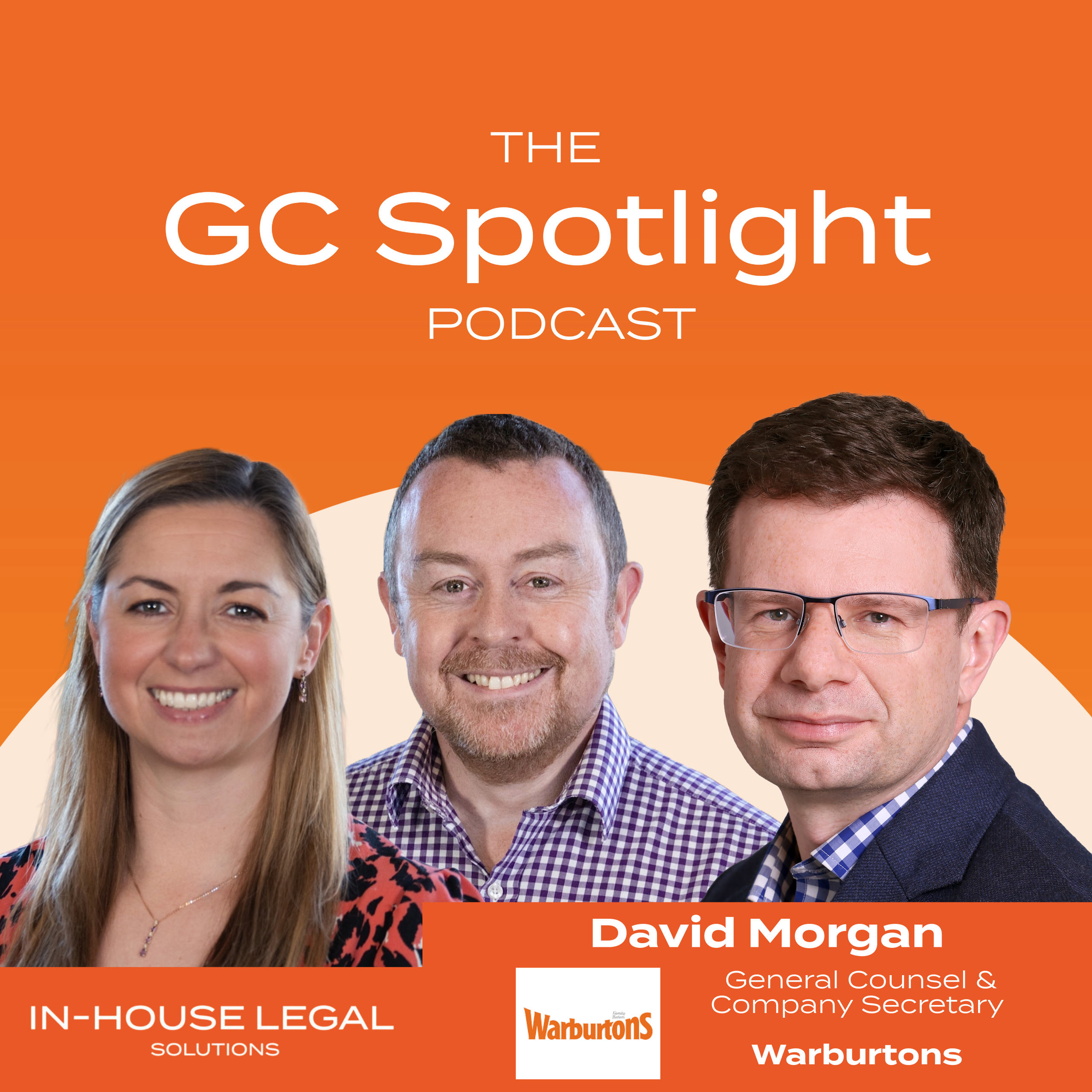
In this episode, David Morgan, General Counsel of Warburtons, speaks to us about how to craft a fulfilling, resilient legal career that balances ambition, leadership, and work-life harmony.
He reveals how strategic career planning, embracing risk, and understanding your business’s unique values can propel you to success—without sacrificing your personal life.
David opens up about his unconventional journey — from a management trainee in the energy sector to a family-owned bakery’s legal mastermind.
Discover how early career reflections on management and ownership shaped his swift move into in-house roles, and how he intentionally built his experience across industries, sectors, and leadership positions.
His candid insights challenge the traditional law firm path, emphasising that meaningful impact often comes from hands-on involvement and understanding the core values of your organisation.
We break down:
- How strategic planning and self-awareness can accelerate your move into in-house and executive leadership.
- The importance of sector diversity and sector-specific contributions in a general counsel role.
- Practical tips for managing risk, building influence without a formal team, and staying resilient during crises like CMA investigations or corporate transitions.
- The delicate art of influencing company culture, working closely with family owners, and embedding legal advice into day-to-day decision-making.
About David Morgan
David Morgan is General Counsel and Company Secretary at Warburtons, where he leads a small, lean legal team supporting a 5,000-strong, family-owned business. Before Warburtons, David held in-house legal roles at Northern Gas Networks, Manheim (Cox Automotive), Two Sisters Food Group, and CPL, where he led the business through an 18-month Competition and Markets Authority investigation.
Alongside his in-house career, David is a governor at Leeds Beckett University, a board member of the Gorse Academies Trust, and a mentor with One Million Mentors.
Read the full transcript:
Brian: Hello and welcome to GC Spotlight, brought to you by In-House Legal Solutions, the podcast that takes you behind the scenes with some of the legal leaders from the UK’s best known brands. I’m Brian Noon and I’m here with Lauren Cannon.
Lauren: Hello.
Brian: And together we are the co-founders of In-House Legal Solutions and your hosts for today’s podcast. And today I’m delighted to welcome David Morgan, who is the General Counsel and Company Secretary of one of the UK’s favourite bakery brands, Warburtons. Thank you very much for coming on David and welcome.
David: Thanks for inviting me to be here.
Brian: Right, so why don’t we kick off then with why did you get into law, what was the first reason?
David: Well, I had a career before law. I started off on a graduate management training programme in a gas distribution network place called Transco. I was there for about three years. Then, of all places, I went to the Institute of Chartered Accountants in England and Wales, the professional body for accountants. That was enough to make me think, what’s the complete opposite of accountancy? Law is what struck me. So I then studied part-time to do my postgraduate diploma in law and then went back to university for a year in my late twenties, which was a different experience to how I remembered my early days of being a student.
The reason was general management, being at the ICAEW, wanting something different to lots of the accountants I met. One of the things that was quite difficult in those jobs was working out how to manage my career, because I’d done bits of project management, bits of business analysis, bits of training people, bits of report writing, and I couldn’t work out where you went with your career. I knew I didn’t want to be an accountant, I’d met enough of them. Law seemed to me to be a place where you could have structure, a sense of direction, and a degree of ownership of your career. At least that’s how it struck me as a non-lawyer at the time. So, finished the year back at university, then a training contract at Addleshaw Goddard, and I haven’t looked back since.
Brian: There we go. You weren’t in private practice all that long, were you? What happened there, when did you move on?
David: So I did my training contract, stayed for six months, and clearly in order to go after six months I’d been applying for stuff outside private practice quite quickly. My view of private practice was that it was actually too rigid, with limited expectations of what you could do and what you should do. I felt there was a “you’re now one year PQE and here’s the kind of work you do” structure, and you work your way up to four or five years PQE, then maybe legal director or senior associate, then salaried partner, then equity partner, with expectations tiered along the way. That felt much too structured an environment, and I thought actually limiting.
It also struck me as being a rat run, stuck on a hamster wheel, running hard to chase something at the very end, sacrificing your time to a firm in return for a reward dangled years away. I had no appetite to be part of that machine. I wanted to take much more control of my own career and reclaim the important bit to me, which is having a life outside of work.
Brian: So do you think having that original short career before law also gave you a different view of what a job could look like, what a career could look like?
David: It certainly gave me a different view of expectations of yourself and of what law firms should be doing. It astonished me that some of the work trainees would be doing was paginating and numbering pages, putting together bundles of documents. In non-legal practice you could have similar activities, maybe putting together a file for a business case, and it wouldn’t be done by someone with a degree and postgraduate qualifications. That sounds a bit pompous, but for me there was a definite sense that you could do much more than what private practice thought you ought to be doing. I think that was born out of having experience elsewhere: after a year at Transco on the graduate management training programme, we had very high expectations, we’d already had promotions, and we were expected to rise as quickly as possible, gathering as much knowledge as we could. So it was a surprise to find this limitation in private practice, the complete opposite of my earlier career’s expectations. I’m sure things have changed a huge amount in the decades since I left private practice.
Brian: So what point during your training contract did you establish that the traditional law firm pathway, eventually becoming partner, wasn’t for you? Was it early on?
David: By my second seat. My first seat I’d already reached “this is bonkers,” and by my second seat I decided my initial view wasn’t wrong, it is bonkers. Then I had to get through the third and fourth. One of my potential mistakes when interviewing for the NQ role at Addleshaw’s was talking about the fact that I might want to go in-house, which is almost like saying “you can hire me, but I might leave.” They might not have expected it to be quite so quickly, but I was really clear by then that private practice wasn’t for me, my personality, and the kind of things and judgements I wanted to make. So yes, it was very soon.
Brian: You’ve talked about how you formed a plan for your long-term career at an early stage. Can you tell us what that plan looked like and how you built it so early?
David: The planning aspect started when I wasn’t yet a lawyer. I’d already started thinking about how you manage yourself and your future direction back at Transco and the ICAEW. During the graduate management programme at Transco we did lots of competency-based interviews for our next moves, so I’d already reflected on experience, competencies, and skills. By the time I got to the ICAEW, having seen lots of senior members from the Big Five (as it then was, later the Big Four), I had a view of how you get there. By the time I’d chosen law and done the training contract, I was able to start mapping out: I want to go in-house, where do I want to go after that, and what knowledge, experience and skills do I need to make sure I’ve got as many opportunities as possible and that my future is as fruitful as I can make it. So it was born out of my time not being a lawyer that informed my decision-making and planning once I was one.
Brian: Not all lawyers plan that early in their career, they’re often more open to what happens to their pathway.
David: [laughing] You’re not sat there when you qualify thinking, “I want to be a co-founder of…”
Brian: No, I really didn’t. That’s a handbrake turn in what was otherwise a very traditional pathway. Hats off to people who plan at such a junior stage rather than going down the traditional partner pathway. So where did you go after Addleshaws, what was your first stop?
David: My first stop was Northern Gas Networks, which, by the way, was a business bought out of Transco. So I had the benefit, moving in-house for the first time at six months PQE, of going to a business just bought out of the very first place I’d worked. When I left Transco I was working in their regulatory and compliance team: public gas transporter licences, competition, protection act, dealing with Ofgem. I knew the director of legal, he’d been at Transco and was then at Northern Gas Networks, so it was a relatively easy transition. I knew a lot of the framework of how the business operated and some of the people. I was really just bringing some extra legal bells and whistles to pre-existing experience.
Brian: Was that a good introduction to in-house law, or was it what you expected?
David: It was what I wanted, which is a slightly different answer. What I wanted was to get in-house, ideally on the same salary or more than in private practice, to beat that “you always earn more in private practice” nonsense. It was probably the easiest way to get in-house experience in an industry I’d already worked in a non-legal role. It also had lots to do, since it had just been bought out of Transco there were transitional service agreements, IT contracts, policy and precedents. It was in a setup phase, so it gave me big contracting experience, particularly in IT, which I thought might serve me well. I’d have preferred a more dynamic, faster-paced place, but utilities aren’t known for that. Compared to Bitcoin it’s probably not as risky, but it gave me what I wanted.
Brian: So what led to the decision to move on?
David: After a few years I thought, well, I’ve now done the big consultancy agreements, the big gas control contract, the setup stuff. What I saw ahead was rinse and repeat, probably even less rinsing, just more repetition of similar things. On my plan: commercial contracting done, some regulatory work done, but what about employment work, dispute resolution, working with broader management? I needed to build out the boxes still empty on my list. The role at Manheim, Cox Automotive, came along, their first lawyer for that business, part of a $6 billion American conglomerate, the first time they wanted someone in Europe to manage that business as a lawyer. I put my hat in the ring and got the job.
Brian: What was the difference moving to Manheim, being on your own after a bigger legal team?
David: Well, actually Northern Gas Networks was just me and Mike Ashworth, the director of legal, two of us for a roughly £400 million turnover business back in 2006. Manheim was probably a £200 million turnover operation as part of the Cox conglomerate spread across Europe. My reporting line switched fairly quickly from commercial director to finance director, but that gave me exposure to a lot of the senior team quite quickly. The decisions were my own, and I quite liked that, it gave me a chance to do my own thing my way, and if I got it wrong I’d bear the consequences too. That’s the biggest difference, it’s your responsibility.
Brian: Did you feel isolated moving from having some support to being on your own? How did you find a support network, and how did you develop your own technical skills?
David: My view was that thankfully I was confident enough in myself and my abilities not to need one. At Northern Gas Networks, Mike could review some of my work, but he wasn’t doing employment law, disputes, or auctions law, which existed at Manheim. How did I learn it? Like any new thing, you can see enough from private practice or documentation to know how people draft, and drafting covers employment, regulatory, disputes, commercial contracting, it’s one skill. The content itself is statute, contract and tort, you read it. The bit you don’t really learn, and I think it’s better not to have too much of a mental network for, is risk and judgement, knowing when to become more anxious about something. I was probably, by virtue of not being a lawyer originally, a bit more open to taking risks in the first place, and over time I’ve become even more relaxed about it, because the more you see, the more you realise how little actually matters in the end. I think it was better not having too heavy a network, because I worry it might have made me a more cautious operator rather than learning as I went. It’s the same for anyone setting up a business, do you go to a bunch of mentors telling you what not to do, or do you just take a flyer?
Brian: There’s a real mix, isn’t there. We’ve certainly asked people we trust along the way, people who’ve trained us or been more senior, “here’s how we’re going to deal with this, what do you think?” Some have been honest and said “don’t do that, terrible idea,” others have supported us. But a lot of business building is winging it, seeing how it goes, being honest when something hasn’t gone well, and being confident to change track. When we started the business in 2016 after moving to Liverpool, there weren’t many alternative legal service providers out there, so there wasn’t a huge amount of established territory to talk to anyway.
David: At some point you come across territory that’s greenfield and you’ve got to do your own thing. I’m interested, as lawyers turned business owners, what’s the difference for you in how you think about stuff and risk-taking? Becoming a business owner is quite a leap versus doing technical legal work.
Brian: I think the bigger jump would have been going straight from private practice, but we were both in-house lawyers for many years, and you learn that judgement and autonomy in-house. We had to use that tolerance for risk to start a business from scratch, we didn’t take any funding, unlike lots of businesses when they launch. Without that in-house experience of being the person saying “yes you’ve come to me with a risk, but I think it’s pretty slim, my advice is we’re okay to go ahead,” I think it would have been harder to build that tolerance.
Lauren: I’ve always been quite keen on working within a business, being a corporate lawyer, I loved seeing how different businesses worked, meeting founders and senior directors. Going in-house was almost a natural step, and running a business was always something I wanted to do. I’ve probably always had a bit more of a risk-comfortable approach, similar to David. We complement each other well, we push and pull at the right times, and operate on slightly different sides of the business so we don’t always have to agree, Brian more on the finance side, me more on compliance. That’s healthy for two people running a business.
David: That’s a good articulation of all good family businesses too, finding where you make your best contribution, which also avoids conflict.
Brian: Exactly, which brings us to your own experience. Let’s fast forward, from Manheim, then Two Sisters, and then CPL, where there was a bit of a dramatic time.
David: The competition authority investigation. By that point I’d spent enough time in the trenches at Two Sisters that not much would throw me off an even keel. At the time CPL was a private-equity-owned business, and we’d tried a number of exit routes, secondary buyout, a listing. That was one of my remaining boxes to tick, experience of a listed business, which I still don’t have. For various reasons it couldn’t exit at the right price, so it went on an acquisition strategy. On the day the CMA turned up, I was on a call with the Scottish Traffic Commissioner trying to transfer a vehicle licence for a business we were buying out of administration, which normally takes months. While on that call, the sales director came in to say some people downstairs had a notice and wanted to get in. Thankfully, having briefly been a competition lawyer at Addleshaws, I recognised it as a CMA dawn raid. I had to conclude the call with the Traffic Commissioner while telling the sales director what to do with the eleven people who’d turned up, then shuttle between that and dealing with the CMA over their two days in our offices, which kicked off an 18-month investigation into CPL’s historical business practices.
Brian: Wow. Were you heavily involved in that?
David: Yes, in a lot of detail. On the first two days I was fielding calls from the CEO, CFO, and private equity directors, all wanting to know how it ends, which is tricky on day one of an investigation. They wanted reassurance that the business could still be sold, what it would cost, and what it meant for the exit, they wanted the crystal ball answer, “don’t worry, here’s how we manage it, the impact won’t be severe.” They definitely didn’t want to hear “this could be 10% of turnover, the business could sink.” On the same day I was also deciding which law firm to bring in, and had a couple of calls trying to work that out before they joined on day two. I was involved in all the witness statements, the document-gathering exercise, speaking to the whole leadership team, attending board meetings to give updates, working closely alongside the appointed law firm on disclosure exercises and meetings with the CMA in London, and the response to the statement of objections. I’m quite hands-on by nature, reading all the documents, getting into the detail, reading all the position papers, even drafting some of the first drafts myself rather than just giving updates. That’s typically what I do in every business I’ve been in, I get into the detail. It was intense for a period.
Brian: Did you find that hard to manage, not just legally but personally, with everyone looking to you for answers? Were you able to leave those problems at work, given you’d said earlier that work-life balance was important to you?
David: I’m blessed by being an extremely good sleeper, and someone who doesn’t worry too much, there’s a job to be done. As for giving comfort to people seeking answers that can’t yet be given, you can only do what you know and give the best answer you’re capable of giving, and I try not to sweat too much about it. That’s not to say it wouldn’t occupy my mind on a weekend walk, and I’m conscious I’d have been partly thinking about work during family time, whether that was the CMA investigation, or the Two Sisters acquisition we completed in six weeks that then went into a Competition and Markets Authority investigation, or the Health and Safety Executive and Food Standards Agency prosecutions there too. You can carry some of that thinking in your head, but not so much that I couldn’t sleep well or that it ruined the balance. I think I have a healthy disregard for being responsible forever, I’ve got a job to do, and I try to do it to the best of my ability without it consuming me.
Brian: GC Spotlight is proudly brought to you by In-House Legal Solutions. If your legal team needs additional capacity or project support from experienced in-house lawyers, we’d love to help, find out more at inhouselegalsolutions.com. So, take us to your next move, where you are now, Warburtons. Crusts or no crusts?
David: No crusts.
Lauren: Actually, my favourite…
David: Fruit loaf, teacakes and pancakes, I’m cursed with a sweet tooth, and it’s a nightmare in the office because right next to the kettle and coffee machine on our floor are all the Warburtons products. I can’t resist the smell and allure of a teacake sneaking its way out of a packet. Once a fruit loaf, teacakes or pancake packet is opened, it slowly gets worked through, one pancake, still warm, second pancake…
Lauren: I feel like I’m a very good product quality tester for that range, probably done my health no good.
Brian: Certainly not a bad place to work.
David: Definitely not.
Brian: So tell us about the team at Warburtons, did you build it yourself?
David: It’s a really small team. We’ve got a part-time head of legal, been there more than fifteen years, and a part-time legal exec, been there over ten. We used to have an assistant company secretary who, when she retired, we didn’t replace, which is one of my standard things, keeping it lean and efficient. When I joined during COVID, the business was around £500 million revenue, we’re now just over three-quarters of a billion, still around 5,000 staff, and we manage the vast majority of legal work between the three of us.
Brian: You’re very hands-on yourself, aren’t you?
David: Today, for example, I’ve been in a meeting on general company secretarial and board matters, then commented on some contracts, then provided advice on a settlement agreement for an employment matter. I’ll do everything from NDAs, heads of terms, letters of intent, long-term agreements, ordinary commercial contracts, employment law advice, regulatory advice, data protection. Definitely hands-on, because the business doesn’t need someone 100% strategic when it’s predominantly a UK business selling to about ten customers, with 5,000 staff and 32 depots, but lots of long-standing suppliers. There isn’t a 40-hour week where you just manage a team and think strategically, it’s about risk, insurance, enterprise management, working with the exec team, supporting the board, and doing the legal work and other things too.
Brian: Are you on the board as well?
David: I sit on the board with the Warburton family and our non-exec director. Am I there offering worldly advice and critiquing their decision-making? No. Am I there to take notes of what’s said, and answer questions on legal, insurance, or enterprise risk matters, or speak to specific projects around acquisitions or disposals? Yes. I stick in my lane there. I think “a seat at the table” is one of those slightly overstated objectives in general, really we should be asking what it is you do that makes an impact, and how, and I think that’s made lower down in an organisation, with the people making day-to-day decisions, fellow members of the leadership team, procurement, the people team, that’s where you can make an impact.
Brian: Does being so hands-on give you the chance to really impact the day-to-day lives of the 5,000 staff you must be working with a good handful of?
David: I hope so. We’ve twice surveyed what people think about the quality of our advice, how pragmatic we are, our SLAs, and the responses have been very positive, which is heartening. I don’t think I’m changing anybody’s life, I’m not a mental coach enabling someone to perform in a vastly different way. But we oil the wheels of the business rather than being grit in it, stuff gets done. Whether that’s transformative, I don’t know.
Brian: I’m sure it doesn’t go unnoticed. So what’s it like working with the founders, since it’s still a family-owned business with the family very involved day to day, what’s the dynamic there?
David: We’ve got Generation Five running the business at the moment, Jonathan, Brett and Ross Warburton, Jonathan’s the one you’ll have seen in the TV ads, working on his acting career. We’ve also now got Generation Six, Ellen, Jimmy, Harry, Jack and Megan, in the business. It’s interesting at the moment because it’s going through that transition from one generation to the next, with Jimmy, Jack and Harry now on the board alongside their fathers. It’s different knowing the people who own the business are there making decisions next to you, you get a clear sense of direction, and a clear sense that this is a family business with a very long-term ethos at its heart, you’re not chasing quarterly end-of-year results. You can approach work differently, and it feels more like a family business when you’re at the kettle chatting to John about the products next to you, or more generally about your weekend. It has a sense of being somewhere other than just a vehicle for revenue and profit, a different cultural resonance.
Brian: What would you say is one of the most important things for a general counsel to be effective?
David: Let me walk through that, because I think effectiveness looks different depending on the business you’re in, there’s no cookie-cutter answer. Northern Gas Networks was different to Two Sisters, different to CPL, different to Warburtons, and even though Warburtons and Two Sisters are both family owned, they’re chalk and cheese. The route to effectiveness in each is different because it’s about that business’s culture, the personalities in it, and its measures of success. So lesson one: work out what kind of business you’re in, and what it really values from its legal professionals, that can have real nuance. Lesson two, as a consequence: be explicit about the contribution you make in that context, don’t be shy about explaining why waxing the wheels matters, in what way, how it helps the business, you don’t need complicated KPIs, a page saying “here’s what we’ve done and here’s why it matters” is enough. Lesson three: the art of listening to senior leaders and adapting to what you hear. There’s sometimes a desire to justify why legal matters, why the rules are important, why with all your experience you should have a seat at the table, and that can come loaded with an expectation of how you should be treated. There’s a lot to be said for humility, listening to what the business thinks is important, and playing back how you’re fulfilling what it actually values, rather than telling it what it should value. So: business context, listening, and being clear (not shy) about how you add value, defined on the business’s terms.
Brian: Fantastic, really pertinent tips for any general counsel role. You’ve also got some other leadership roles, a governor at Leeds Beckett University and on the Gorse Academies Trust board. How have those shaped you as a leader, and how does that transpose into your day-to-day work?
David: It’s quite a hard question to answer in reverse, how has it shaped me. I’ve been involved with Gorse since before it became the multi-academy trust it now is, for nearly two decades, and the impact has been so incremental it’s hard to step back and pin down. I’m also wary of framing it as though you reach some final state of leadership omnipotence, always right, fully formed. If I’ve learned anything, it’s that leadership is fragile, a bit like being a football manager, successful today, gone tomorrow. Gorse gave me a wider perspective on how to think about issues, manage an organisation, and deal with difficult personalities, we had some challenging board meetings when sponsoring what were then called “failing schools,” strikes, adverse publicity. That experience of hard times builds resilience and an appreciation that mistakes happen, you learn where you can and move on. It’s also shown me the power of critical thinking, patience, listening, but also having a point of view you can hold lightly enough to change, while still engaging properly in the debate. At Leeds Beckett, even after four years, I’m still learning how to be an effective non-exec director in an organisation of around £250 million turnover and a couple of thousand staff, in a very difficult public sector setting, universities have a hard time staying afloat and giving students a good deal, within a policy-driven environment around freedom of speech and value. The way it’s shaping me, rather than has shaped me, is again about perspective, and being open to feedback, from the chair of the board in particular, about how you lead an organisation you’re not executively running, but are there to help shape culture, vision and direction. You can really only do that over time, by looking back at where you and the organisation have come from.
Brian: I’d agree, I think leadership is never something where you reach the top and that’s the end of the journey, becoming a leader is really the start. You develop, you learn from others, sometimes learning the right way, sometimes learning by seeing how someone else handled something and thinking you’d do it differently. Especially in a people role, managing a team, developing people, supporting them through change or career progression, it’s a big responsibility, and you’re always learning, never a fully formed product.
David: What about you, Brian, running a business, co-founder, lots of people relying on you, do you carry that lightly, or is it hard to always make the right judgement?
Brian: I don’t think it’s something you can spend too much time dwelling on. There haven’t been many times in the last ten years where sleep’s been difficult, though there’ve been moments where something’s on your mind, I won’t lie. You have to have conviction in the decisions you’re making, but also be humble enough to know when you haven’t made the right call and be big enough to turn around and change course. There are a lot of people relying on you for the business to keep going in the right direction, and that can be difficult. Leading is about having the plan in front of you and making sure everyone believes in it and believes it’s the right way forward, that’s different from managing. You’re leading the team from the front, showing them where you think success and the future lie, because everyone wants to feel there’s development and growth ahead, and see you putting ideas into place. On that note, did you go looking for the governor and non-exec roles, or did they come to you, was that on the plan?
David: Partially, yes, it was on the plan. Alongside knowledge of the law, competency development, and experience across sectors, one of the reasons I started with what was then Morley High School back in 2006 was to gain leadership experience in a non-legal, non-business setting. So yes, I deliberately went out to become a governor, which then became a multi-academy trust due to government policy changes, expanding to many academies, thousands of students, Ofsted and DfE interviews and more. Leeds Beckett was similar, once I felt I’d gained much of what I could from Gorse, and had actually just moved on to another chair role there too, I went looking for something similarly different in scale, somewhere I’d again be the newbie, hoping to contribute but recognising I had much more to learn.
Brian: How do you manage your time, is it long hours at Warburtons, or does it ebb and flow?
David: Not as long as I imagine it would have been in private practice, that’s always my litmus test for whether I made the right choice. I rarely work weekends, I might think about things, but I’m not sitting at a desk. Very rare for me to work weekends, with maybe the exception of Leeds Beckett or Gorse matters, not work-work. It’s a normal half eight in the morning through to six in the evening most weeks, and that’s enough, I don’t consider that excessive. What I didn’t like in private practice was the Friday-night deal closures, corporate seemed to always be “completing” this week, with a mad rush into the early hours, and then it wasn’t completing after all. That really disrupted people’s lives, an evening or a weekend plan could vanish because that’s what the client needed. I have none of that now, which is good.
Brian: Much better. Well, it’s been a great conversation, we’ve really enjoyed it. Two more questions we always ask our guests. Looking back over your career, what do you hope to be remembered for?
David: I tend to be more forward-looking than backward-looking, though I appreciate there’s now sadly more of my career behind me than ahead, that’s me getting old. I’d like to be remembered, if I can, for providing opportunities for people to make their way, not the technical work, not the jobs I’ve had, not the impact on the business, but for providing opportunity for people. That’s something I regret I haven’t done enough of to date, which is why it’s more forward- than backward-looking.
Brian: How would you like to do that, within the law or more broadly?
David: A combination. Continuing with the Gorse and Leeds Beckett work, I’m also a mentor for One Million Mentors, so some mentoring there, and in future, being a mentor, a coach, and where I can, whether through legal internships or helping people in their careers, doing more of that too.
Brian: That leads nicely into our final question then, what advice would you give to aspiring GCs looking to move into the role?
David: First thing I’d say: don’t worry about the job title. Head of legal, general counsel, chief legal officer, whatever it’s called, first ask yourself what gives you satisfaction in the workplace, that may or may not be being a general counsel. It might be the technical aspects of the law, managing a team, engaging with barristers or legal providers on specific work, it might not be the thing you’ve been told you should want. Start with that fundamental question, draw up a plan. For those who do want it: recognise that a general counsel job is different in different businesses, I’m very hands-on, some general counsel would be horrified to see me looking at a supply agreement or giving employment law advice. What you’re actually seeking might be quite a different type of role depending on the business’s scale, going back to CPL, a business maybe 15% the size of Warburtons but with far more disputes, acquisitions, disposals and regulatory activity, so far more legal work in a much smaller business than in a bigger one. But whatever you do, seek breadth of experience across law and across sectors, gain exposure to lots of different businesses, build your network. If you’re keen on a role, apply a lot, expect a lot of rejection, apply again. Build your network with recruiters and executive search firms. Keep plugging away, because it’s as much luck as it is skill, competence or insight. I hope you’re lucky.
Brian: Wow, very sage advice, brilliant. Thank you, it’s been great talking to you, we’ve really enjoyed it. Please do follow us wherever you get your podcasts, keep an eye on LinkedIn and our other social channels, we’ll keep you updated on this and all our future guests. That’s been GC Spotlight, thanks, and see you again.
David: Thank you very much.
More from GC Spotlight
Catch up on more conversations with in-house legal leaders on the GC Spotlight episode archive.
Need additional legal capacity for your team?
If your in-house legal team needs extra support or project capacity from experienced lawyers, In-House Legal Solutions can help. Find out more